
Tell Baqtra
Κυριακή 9 Ιανουαρίου 2011
Access to Mideast and Islamic Resources (AMIR): Open Access Journal: Zeitschrift für Assyriologie ...


Exhibition: Die geretteten Götter aus dem Palast vom Tell Halaf

Pergamonmuseum, Museum Island Berlin
»It would be truly wonderful if the smashed fragments from the stone images could somehow be gathered together, brought to the National Museums and reassembled at a later date. In the case of this collection, it would, however, be a tremendous task, since the sculptures have been shattered into countless, often minute fragments.«
MAX VON OPPENHEIM AFTER THE DESTRUCTION OF HIS TELL HALAF MUSEUM, 1944
Turkey: Ani - Ghost city of 1001 churches

Ani – some call it the City of 1001 Churches, others the City of Forty Gates. Yet no one has called it home for more than three centuries.
Abandoned by its once prosperous and powerful inhabitants, it is situated on the Turkish side of a militarised zone between the border of Turkey and Armenia.
The city of Ani is no stranger to death, destruction and desertion.
Σάββατο 8 Ιανουαρίου 2011
NY Times lists Iraqi-Kurdistan among “41 places to visit in 2011”
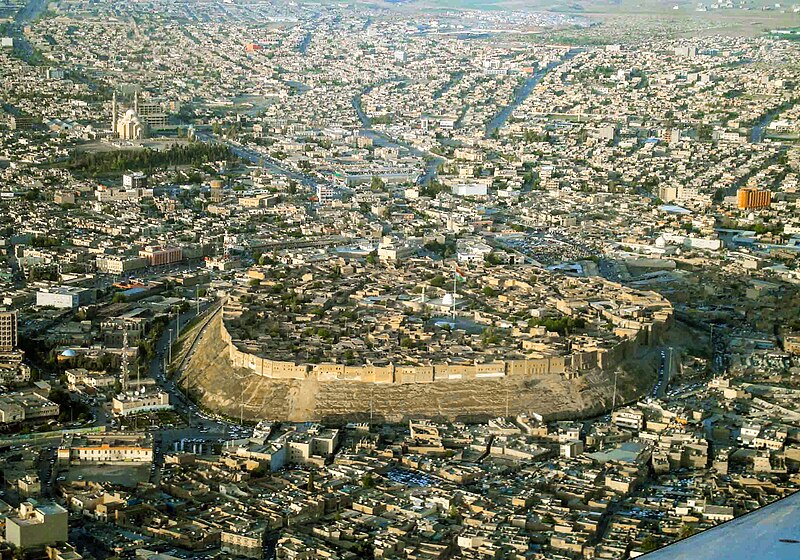
An article in the travel section of yesterday’s New York Times (NYT) lists the semi-autonomous Iraqi Kuurdistan region among the 41 places in the Worlhttp://www.aknews.com/en/aknews/3/208701/d worth visiting this year.
Referring to the relative security and stability this northern region of Iraq has enjoyed in recent years, the NYT provides details of a few of the travel companies offering trips to its landmarks such as Erbil’s citadel which dates back to the Assyrian empire and the site of the Battle of Gaugamela, in which Alexander the Great defeated the Persian king Darius III leading to the fall of the Achaemenid Empire.“Safety, history and a warm welcome in a stable corner of Iraq” the NYT article is sub-headed. According to the Distant Horizons travel company that has been bringing small groups of American visitors to Kurdistan since 2008, the biggest attraction to the region is the opportunity for “authentic cultural encounter”.
“Authenticity is something that can be lost so quickly as development occurs,” the NYT quotes Distant Horizons’ Janet Moore as saying.
Karl Allen (AKnews): k.allen@aknews.com
Funde von Tell Halaf: 27.000 Scherben fügen sich zum Orient-Schatz

Es war die damals größte Ausgrabung der Welt. Von 1911 bis 1913 wurden auf dem Siedlungshügel Tell Halaf in Syrien 3000 Jahre alte aramäischen Skulpturen, Steinbilder und Schmuckstücke geborgen. Es waren Überreste einer gigantischen Palastanlage, die der aramäische Fürst Kapara errichten ließ. Sie zählen bis heute zu den spektakulärsten archäologischen Funden des Vorderen Orients.
Archaeologists Unearthed Byzantine Mosaic Painting in Syria

A mosaic painting dating back to the Byzantine era in the 6th millennium A.D. was discovered in Kfarnboda, Hama. Director of Hama Archaeology Department Abdulkader Farzat said the painting, which is 375 cm-long and 120 cm-wide, carries numerous geometrical shapes and decorations.
For his part, Director of Apamea Archaeology Department Nader Lada said the painting includes drawings taking the shape of squares, each five of which are positioned above each other vertically.
"In the center of the squares is a cross-shaped drawing. The painting, which is dominated by white and gray, is surrounded by a frame of two lines and inside is a geometrical strip of triangles," said Lada, adding that the painting was done with precision and skill.
Hama is rich in Syria's most important mosaic paintings. More than 50 % of the discovered such paintings are found in Hama.
Source
Εγγραφή σε:
Αναρτήσεις (Atom)